


Rack and Pinion Actuator Supplies
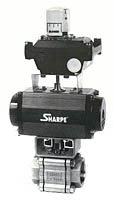
SEMCOR has a long, proud tradition of supplying and fabricating top-performing industrial products for companies throughout the Midwest. Our unwavering commitment to providing quality service through a process consisting of multiple quality checks and automation separates us from our competitors. Our extensive line of fluid handling products includes rack and pinion actuator supplies that ensure reliable valve performance, while also providing a low cost of ownership.
Rack and Pinion Actuator Uses & Applications
Rack and pinion actuators can be used to control the opening and closing of valves. The typical design consists of two racks and one pinion. The movement of the two racks causes the pinion to rotate, which in turn causes the attached valve to turn. Rack and pinion actuators are found in a wide range of industrial applications.
Brands
You will always find the top industrial brands at SEMCOR. You will also appreciate our sincere dedication to providing effective, reliable technical support for as long as you are a SEMCOR customer.
Rack And Pinion Actuator Design and Operating Principles
Rack and pinion actuators convert linear motion into rotary motion through a mechanical gear arrangement consisting of opposing racks and a central pinion gear. As pressure is applied to the internal pistons, the racks move in opposite directions, rotating the pinion and actuating the valve. This design provides smooth, repeatable operation for quarter-turn valve automation applications.
Because of their compact footprint and balanced torque output, rack and pinion actuators are commonly specified for automated process systems that require dependable valve cycling and precise control.
Selecting A Rack and Pinion Actuator
Choosing the correct actuator involves matching performance capabilities to the valve and process conditions. Proper sizing helps ensure reliable operation while maintaining system efficiency.
Important factors to evaluate include:
- Valve torque requirements
- Operating pressure
- Valve size and type
- Required cycle frequency
- Ambient operating conditions
- Mounting specifications
- Automation requirements
- Desired fail-safe functionality
Reviewing these variables during the specification stage can help reduce installation issues and improve long-term performance.
Advantages Of Rack and Pinion Actuators
Rack and pinion designs continue to be widely used because they offer straightforward operation and compatibility with many quarter-turn valves.
Key advantages include:
- Compact design
- Consistent torque delivery
- Fast actuation speeds
- Reliable valve automation
- Simple mechanical operation
- Flexible mounting options
- Compatibility with automation accessories
- Suitable for high-cycle applications
These features make rack and pinion actuators a common solution for both new installations and retrofit projects.
Rack and Pinion Actuator Frequently Asked Questions
What Is a Rack and Pinion Actuator?
A rack and pinion actuator is a mechanical device that converts linear piston movement into rotary motion to operate quarter-turn valves and automated flow control equipment.
How Does a Rack and Pinion Actuator Work?
Internal pistons move opposing racks that engage a central pinion gear. As the racks travel, the pinion rotates and transfers motion to the attached valve stem.
What Valves Are Commonly Used with Rack and Pinion Actuators?
Rack and pinion actuators are frequently paired with butterfly valves, ball valves, and other quarter-turn valve designs.
What Is the Difference Between a Double-Acting and Spring-Return Actuator?
A double-acting actuator uses pressure for both opening and closing functions, while a spring-return actuator uses an internal spring to move the valve to a predetermined position if pressure is lost.
View Products & Contact Us
Please contact us for additional information, including product-specific literature. Our sales and service team can also assist you with product selection if needed.